Treasure Hunts for Dogs: A Simple Way to Meet Your Dog's Needs Indoors
- Katie Nahabedian

- Jan 26
- 5 min read
If you're a dog parent struggling to give your pup enough mental and physical exercise - especially indoors - treasure hunts might be the activity you need. This simple activity has helped countless dogs (and their humans) find calm, focus, and fulfillment without complicated training or expensive equipment.

Who This Is For
Treasure hunts are perfect for dog parents navigating specific challenges: dogs who are reactive or anxious and need calming outlets, households without backyards looking for indoor enrichment options, and dogs where long walks aren't ideal due to physical or behavioral limitations. They're also incredibly valuable for velcro dogs who need to learn independence and practice engaging in calming activities away from their humans.
What Is a Treasure Hunt (and What It's Not)
A treasure hunt is essentially a fun scavenger hunt around your home where your pet searches for their favorite goodies - treats, toys, enrichment items like lick mats, Kongs, puzzle feeders, or snuffle mats, or any combination. The human sets it up, and once the dog has learned the game with some supervised practice, it's a great way for them to to find their treasures and independently entertain themselves.
This idea is different from formal nose work you'd see in classes or competitive trials where dogs search for specific scents like birch or anise with their handler close behind. Treasure hunts are more of a "set it and forget it" independent activity once your dog has the skills down.
Real-World Problems Treasure Hunts Solve
I recommend treasure hunts for all sorts of situations. They're perfect for getting some quiet during a Zoom meeting, transitioning dogs from high-energy activities like play or walks down to rest time, and providing extra exercise on rainy or snowy days when outdoor time is limited.
For anxious dogs, treasure hunts offer a focused, calming activity that helps refill their emotional cup. They can be helpful during scary noises like construction or fireworks, and they give dogs something productive to do when guests visit and your pup isn't comfortable being in the same room with strangers.
Common Mistakes to Avoid
The biggest mistake I see is getting the difficulty level wrong. Make it too hard, and your pooch will get frustrated and give up. Too easy, and they'll get bored. You want to see engagement and curiosity about their environment, and you want to hear that distinct rapid sniffing noise - we want dogs using their noses, not just their eyes.
That means choosing treats, toys, or enrichment items that have a sufficiently strong smell, especially when a dog is first learning this game. A bland, low-value treat that your dog can barely detect might not keep their nose engaged.
Real Examples from My Work
I've had several clients living in Boston where heavy foot traffic, dogs, noises, buses, and trucks created constant chaos. Their dogs weren't coping well and weren't good candidates for long, relaxing neighborhood walks. While we worked on helping those dogs become more comfortable in their urban environment, treasure hunts became the primary way to give them "long walks" around the house - searching and sniffing for food. Combined with other activities, we successfully met their physical and mental exercise needs indoors when the sidewalk wasn't a viable option.
I also have a foster dog, Lacy, who is completely glued to my hip. Treasure hunts give her a way to practice moving away from me while engaging in a calming activity she genuinely loves. It's been crucial for building her independence.
Teaching the Progression
I always start small. First, I create a tiny circle and sprinkle treats, making sure the dog is comfortable eating them off the ground. If I want the treasure hunt to involve enrichment items like Kongs, I practice separately first to ensure the dog actually enjoys using them. (Some dogs get frustrated with the tiny hole on a Kong and need a more open-ended Toppl - practice beforehand ensures I'm only giving them things to hunt that they actually like.)
Once they're comfortable, I sprinkle treats in a larger area and make sure the dog is comfortable moving around to find them. If they aren't finding everything, I help by pointing to areas on the ground near the treats, asking "Is it here? What about over here?" I want to hear their noses really working at this point - that rapid in-and-out sniff, not just eyeballing the floor.
Next, I start hiding treats in less obvious locations: behind a furniture leg, on a spot of rug that's the same color as the treat, in the fold of a blanket, up on the couch. If the dog needs to stay in the room while I set up, I'll give them an activity to keep them occupied and quickly place treats, sometimes even pretending to put one down intermittently.
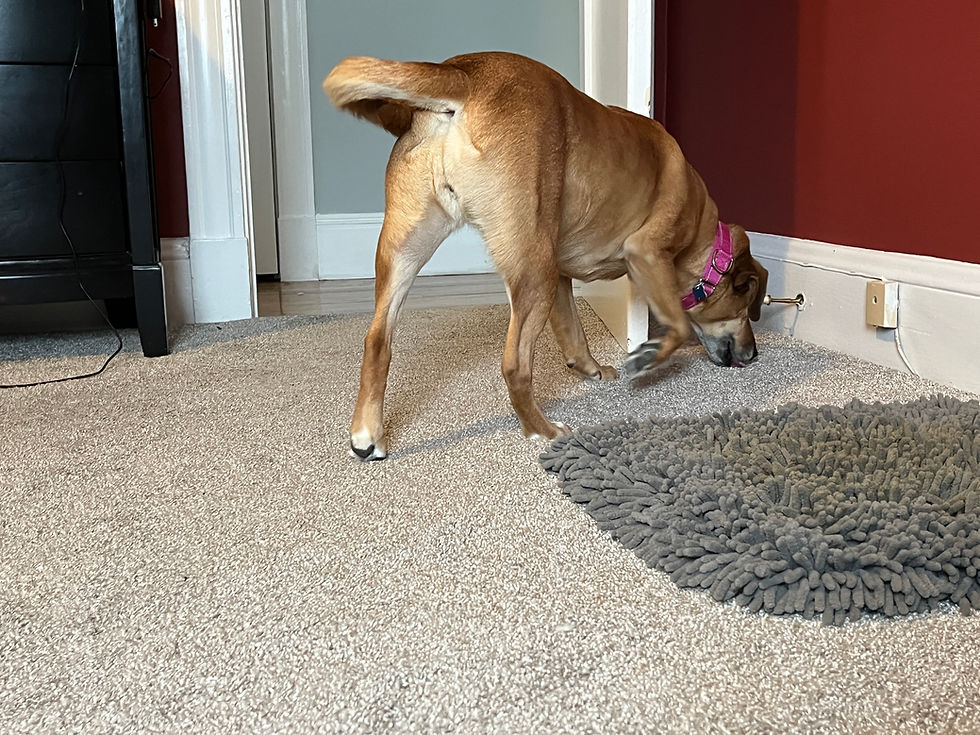
When dogs are proficient and can work independently, I go into a room without them, set up the treasure hunt, then let them in once I'm done so I can go do my own thing. I'll even prep a treasure hunt earlier in the day so it's ready when I know I'll have a Zoom call later.
Signs It's Working (or Not)
You know a treasure hunt is working when your dog eagerly engages, uses their nose to find goodies, and you see an overall beneficial impact - increased ability to rest afterward, decreased reactions on walks, reduced barking, etc.
If treasure hunts are instead amping your dog up with frustration, or they are showing boredom and not seeking treats altogether, you need to modify the activity or substitute something else. The goal is calm engagement, not stress.
Meeting Needs Without Draining the Human
Treasure hunts are great for meeting dogs' needs without exhausting their humans. They can be set up quickly, especially with practice. They're excellent "bang for your time buck" if your dog is really into them and thoroughly checks every nook and cranny for treats.
Because they're an independent activity once set up, there's less burden on you to actively supervise enrichment time, assuming your dog can safely do this unsupervised. (Watch out for potential ingestion of toy parts or enrichment items, or potential scuffles if you have multiple dogs!)
The Big Takeaway
Meeting your pet's needs doesn't have to be complicated or expensive. For some dogs, a fantastic 15 minutes of physical and mental exercise can literally come from tossing a handful of treats in different areas around a room and letting your dog go to town.
Sniffing is incredibly calming and fulfilling for dogs. Treasure hunts are a fun game that gives them choice in how they navigate their environment and engage their senses. And sometimes, doing less - setting up a simple activity and stepping back - is exactly what both you and your dog need.
Treasure hunts show that enrichment doesn't require fancy equipment, extensive training, or hours of your time. Sometimes the simplest activities are the most powerful and rewarding.
For more activity ideas, check out this blog post about other indoor games for dogs. And if you need help brainstorming or troubleshooting activities like this, check out my in-person and virtual private training lessons!


